
Metroid Prime Review
The House That Retro Built

This review is part of the Metroid Prime retrospective series!
2025 is proving to be the year of long-awaited releases. With Hollow Knight: Silksong finally out in the wild, another game announced even longer ago is soon to follow: Metroid Prime 4: Beyond. You all already know I’m looking forward to it, and you know just as well that I’ve got a lot on my plate this fall. All the same, I’ve decided to try my best to cover all three of the previous Metroid Prime games in preparation for Prime 4. This is a very unique sort of sub-franchise, and there’s something interesting to say about every game in the series. Plus, it’ll actually be my first time playing through Metroid Prime 3: Corruption, even though I’ve owned the trilogy for a few years now. Well, there’s no better place to start than where it all began - or rather, where it all began again for the Metroid franchise.
The name Metroid Prime is a very interesting - and fitting - one. While the 1986 original Metroid and its Game Boy sequel were early genre pioneers, it’s not exactly unfair to say the franchise really got off the ground with 1994’s Super Metroid. It holds up well enough today to remain among the series’ most revered titles, having an influence on countless creators seen best through the use of its name in the colloquial genre known as “metroidvanias.” They’re a darling genre of the indie scene today, and the fad has started to catch on with larger studios as well. Nowadays, the series is running strong thanks to Samus Returns’ 3DS remake and 2021’s phenomenal Metroid Dread. The immediate aftermath of Super Metroid was not nearly so exciting, though. The series saw no new releases for eight years after the fact, but it turns out that was just enough time for fans of Super Metroid to get to work on creatively reinventing the franchise. Retro Studios, a new Nintendo subsidiary based in Texas, was working on a way to bring Metroid into the modern day. The result was a game that adapted the core elements of Super Metroid into an experience that felt brand-new. Prime is right; it was a new beginning.
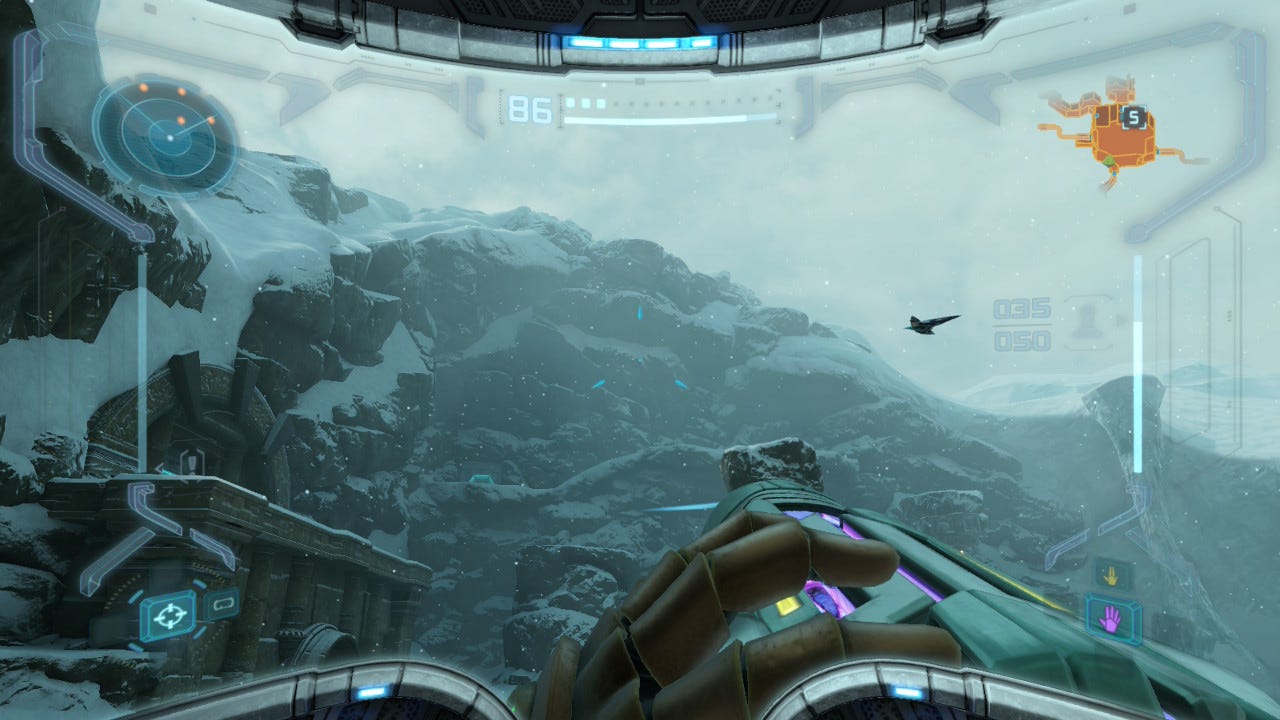
Unsurprisingly for a bunch of Americans getting their hands on a Nintendo franchise in the early 2000s, Retro’s way of reinventing Metroid involved turning it into a first-person shooter. More surprising was just how unlike most shooters it was. Even as fairly recent titles like Half-Life and Halo: Combat Evolved had begun to emphasize more immersive worlds and bigger stories, open-ended exploration hadn’t really found its way into the genre much yet. Before other studios were even aiming for it, Metroid Prime delivered a veritable masterclass of world design with Tallon IV. Every zone is distinctly different, and their soundtracks create the perfect ambience for every environment. Important locations feature clear, memorable landmarks. Newly-explored areas are automatically tracked on a detailed, yet easy to use full-3D map. The world not only cleverly networks together as you progress, but effectively teases you with unreachable ledges and unbreakable obstacles you’ll just be itching to come back to with the right tool later. Like any good metroidvania, the sense of momentum as every discovery pushes you towards the next is nigh irresistible - especially after you get past the game’s admittedly-slow start.
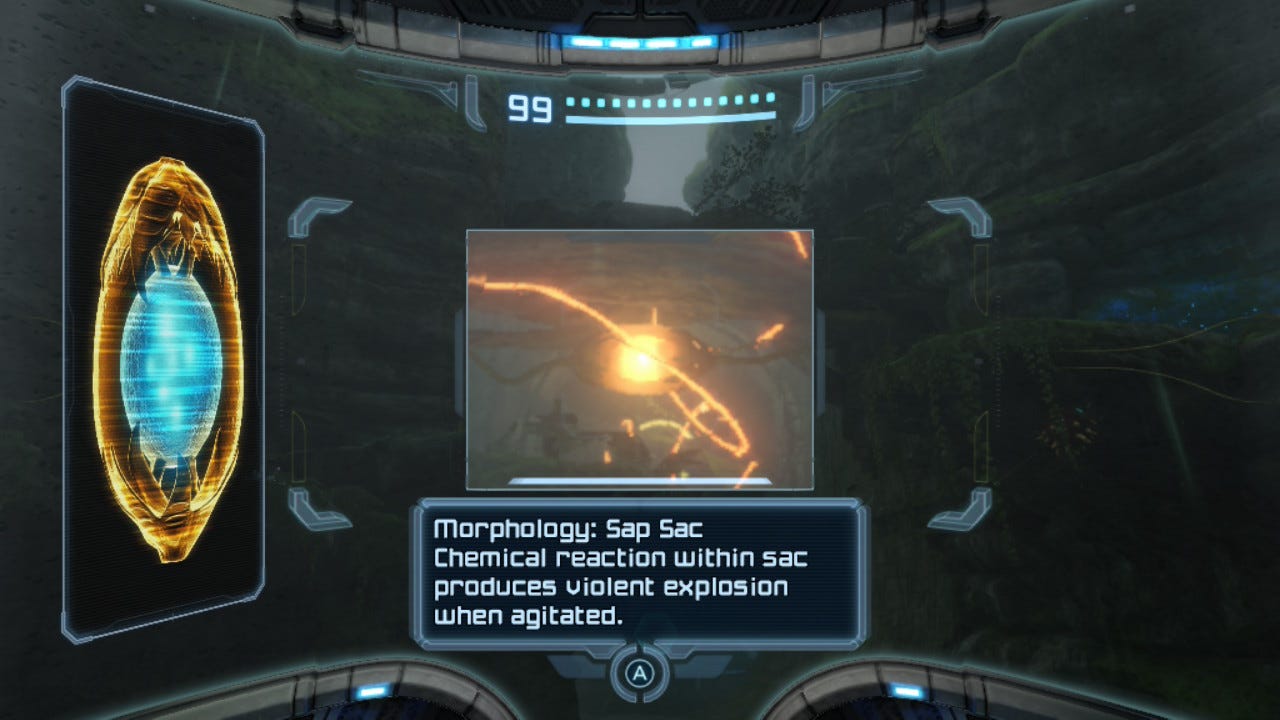
Retro’s mastery of world design extends far beyond the functional aspects. Tallon IV’s zones are each rendered in painstaking detail. I’m using screenshots from the game’s 2023 Switch remaster, but the Gamecube original hardly looked any worse. That’s not a knock on the remaster, but a massive credit to the original, whose excellent visual direction has not aged a day compared to the hardware. The level of attention paid towards the ecological grounding of each zone’s flora and fauna was almost entirely unheard of in 2002. From remnants of the planet’s long-dead Chozo civilization to evidence of the deadly Phazon substance’s toll on the ecosystem, every area feels alive - and the first-person perspective truly immerses you within them. For everything outside the limits of “show, don’t tell,” there’s the ingenious Scan Visor. This clever option lets you scan just about anything that might pique your interest, be it an obstacle you need to pass or an interesting plant. Not only does it help players learn how to progress through the world or beat tricky enemies; it allows them to study everything they might possibly want to know about the world and its inhabitants with log entries. Retro is practically inviting you to check their work if you just can’t believe they actually came up with everything in front of you.
While Metroid Prime’s differences from other shooters were a great benefit for its world design, it didn’t help the game’s control scheme at all. Despite releasing well after Halo: Combat Evolved defined how shooters on console should control, Prime’s controls on its original Gamecube release are downright archaic. The left stick not only moves Samus, but turns her view left and right. To aim, you must hold the R button down and move the left stick, which of course prevents moving. The right stick is too busy letting you switch beams, after all. Since the R button toggles aim, you shoot beams with A and missiles with Y. I’m glad I only got around to this game after Metroid Prime Trilogy on the Wii released, because the controls there and on the Switch remaster are significantly improved. Trilogy makes excellent use of the Wii remote’s pointer function. The Switch remaster includes more standard twin-stick movement and aim controls, options for gyro aim, and a control scheme that uses the Joy-Cons to mimic the Wii controls.
Although these updated control schemes do a lot to smooth the experience out, I would still say the gameplay of Metroid Prime doesn’t quite reach the heights of its world design. The exploration is the part that feels best. Samus’ jumps are high and floaty enough to make platforming fun while still being weighty enough to make them responsive. Many small crevices require you to curl into the Morph Ball, which has its own suite of upgrades. It’s fun to roll down hills or boost along with the Boost Ball upgrade in this form even outside of areas which require it. Using the thermal and x-ray visors to see in the dark or find secrets inside of walls feels clever. While movement upgrades like the Space Jump and Grapple Beam help your backtracking journey throughout the world feel snappy, they pale in comparison to the 2D Metroid games' faster, more agile movement. A wider suite of movement tricks would have been fun to play with for the relic hunt at the end of the game, where you must track down twelve relics to open the final area. If you know where to look, either by guile or from a previous playthrough, a surprising amount of the relics can be found during the middle of the game. For most players, though, this relic hunt acts as a late-game speed bump that leaves the game just barely overstaying its welcome.
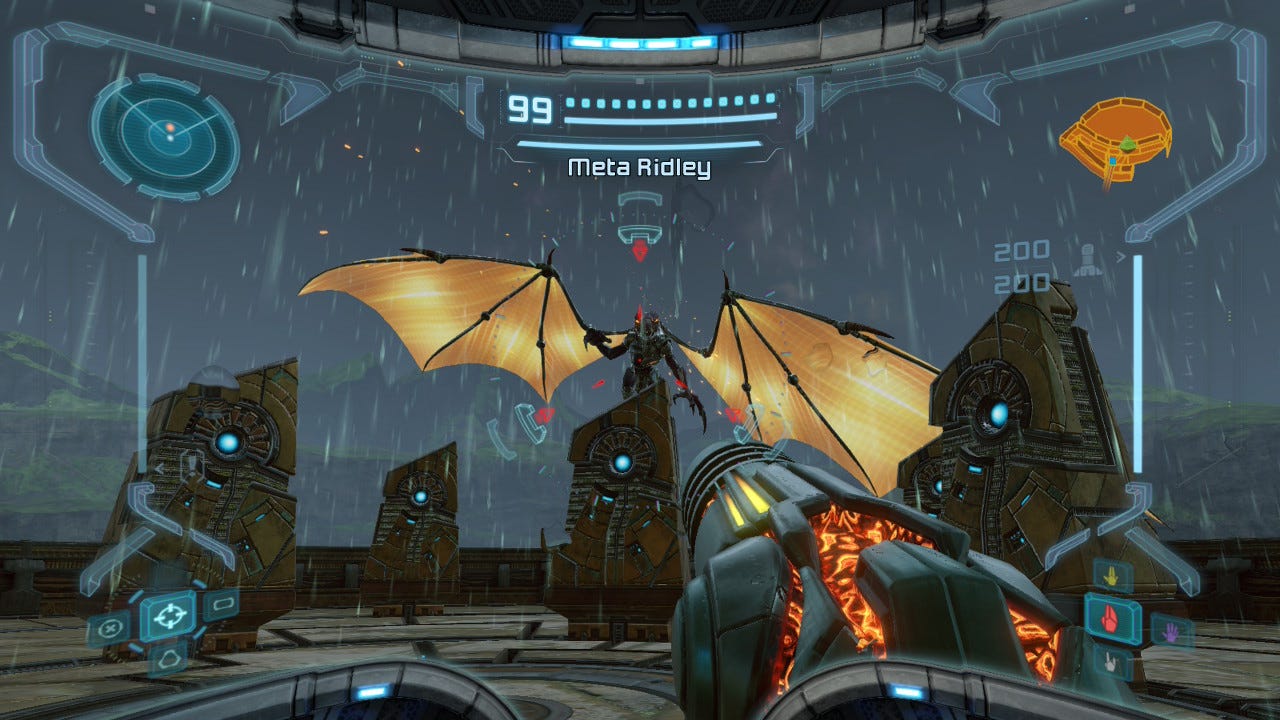
As for the shooting part of this shooter, there’s good reason I left it for the end. It’s not bad, but it’s not a highlight, either. It gets the job done, though combat is clearly not what the game is really about. Aim is not much of a factor thanks to a lock-on system, which was clearly the only thing that made the horrid original control scheme work at all. Locking onto enemies or other types of targets keeps Samus’ aim focused on them, allowing you to circle-strafe your foes and enabling you to sidestep by tapping the jump button while holding left or right. Though some weapons, like the quick and powerful Plasma Beam, can occasionally benefit from manual aiming, locking on pretty much does the trick; missiles and the Wave Beam even follow locked-on targets automatically. The sidestep is handy for dodging aggressive enemies like space pirates, but it can be finicky, resulting in jumps when you want sidesteps. It’s ultimately more about understanding when to shoot and what to shoot things with than it is about exciting gunplay, but powerful options like the Super Missile can still satisfy.
Metroid Prime is rightly remembered as a classic for its unforgettable world, atmospheric soundtrack, and wonderfully-paced sense of exploration. Even though its movement and combat didn’t break boundaries, it simply placed you in the shoes of an interstellar explorer like no game had before. With so much to take in and the world goading you on at every opportunity, it’s the kind of game you can sink deep into while you forget about real life for a while. Though its sequels all tried to innovate in their own ways, Prime arguably remains the greatest in its own sub-series just for its sheer command of design fundamentals. Hopefully Prime 4, having learned from the franchise’s past and being designed for modern hardware and control schemes, can combine Metroid Prime’s best features with even better control and combat. Even if it does, though, this game will always be worth your time.