
Castlevania (1986) Retrospective
Limitations, Innovation, and Challenge

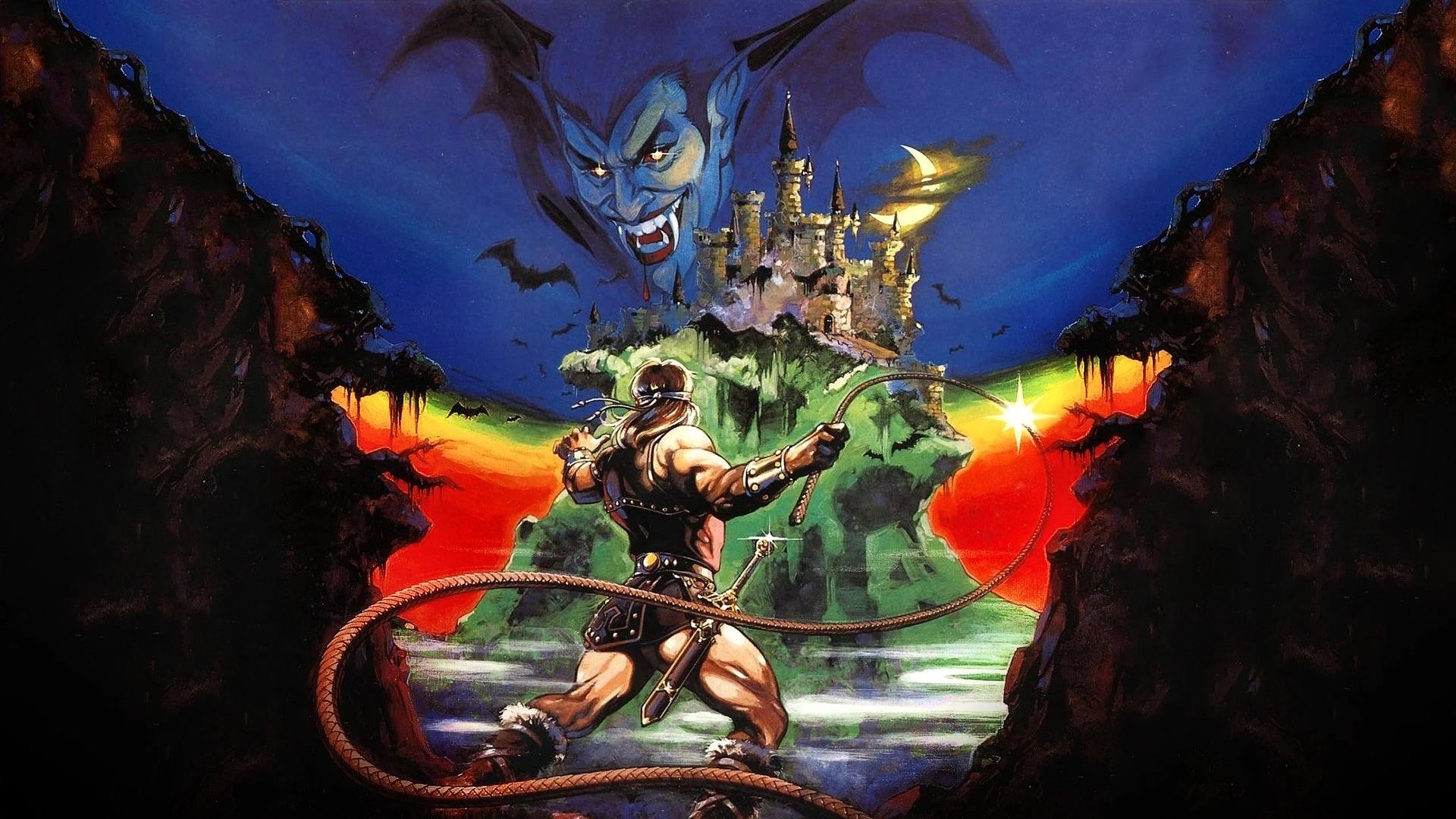
Part of CastleVember 2025!
Our modern gaming landscape is a very different thing to the world of gaming in the ‘80s. Games at this point were still mostly arcade-style score attacks unconcerned with telling stories or having much of a real beginning or end. The idea that a game could be scary or even just atmospheric was pretty laughable to people who were most accustomed to Atari 2600-level visuals. The NES was only beginning to make it seem like video games had a future after Atari’s non-stop output of low-effort slop led to a massive market crash. Regardless, the reinvigorated home console market meant games had to change. Endless, looping quarter-munchers weren’t nearly as novel when you were playing them at home without your pocket change on the line. Games were expensive and people wanted their money’s worth, even if the amount of space on a given NES cartridge averaged well under a megabyte. How did you get the most playtime out of the least content? Simple. You made the content really damn hard.
You may be asking “But how do you keep it fair?” or “But how do you keep it satisfying?” or the like. All reasonable questions, but not ones that designers of the era often knew the answer to - or even cared about. Ideas we throw around casually today like “level design” and “difficulty curve” were little more than nascent concepts in the brand-new world of games that were also stories. Even Nintendo, whose ever-careful developers remain the masters of the fundamentals, wasn’t above a few cheap tricks and unclear puzzles in these times. This is where Castlevania comes in. Konami is trying to do so many things that haven’t been done before with this game. The hunt for Dracula was going to feel tense and spooky, inspired by the Hammer horror films of the fifties. The game was going to be tough as nails, but not because you ran out of continues on a falling rock you could never have reacted to. Its challenges would be set out in front of you every time. You would always have the tools you needed at your disposal. Perhaps most surprisingly of all, you wouldn’t get sent all the way back to the start for anything.
Sound familiar? Maybe this reminds you of Dark Souls, Hollow Knight, Resident Evil, or any number of beloved games. These things are all the hallmarks of the best kinds of challenging games we have today. Castlevania embodies the first steps towards challenging game design that was meant to satisfy rather than frustrate. Castlevania was the future.
Breaking Down the Gates
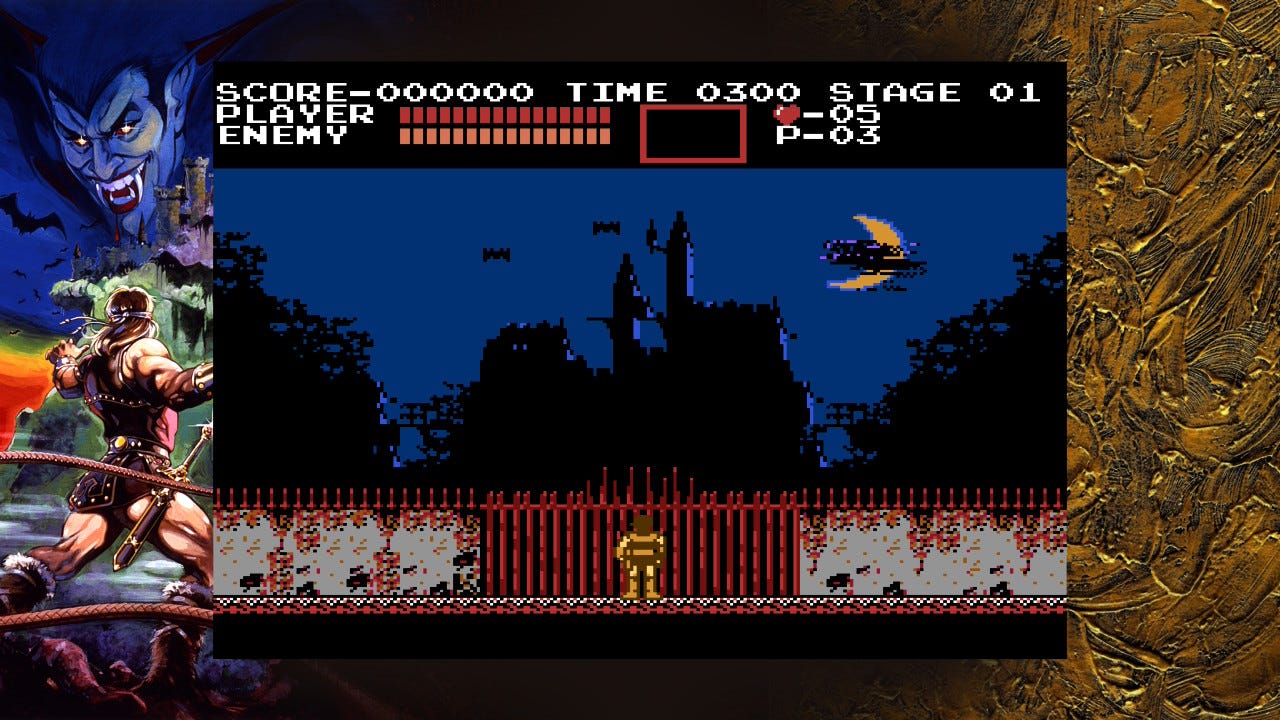
Crucial to everything Castlevania aimed to do was its unique control scheme. While Super Mario Bros. set the standard for platformers as a fast, nimble genre, Castlevania wanted to slow things down. Simon Belmont walks at a moderate pace. Jumps don’t go too high or far, and you can’t change direction once you’re in midair. Navigating the levels often requires slowly climbing stairs, which you can’t jump on or off of. Attacking with the whip takes a moment, but it’s a powerful attack with long range. Finally, you can only carry one of the five helpful sub-weapons - each of which serve valuable niches - at a time. To some, this might sound like making your character deliberately weak, but Simon doesn’t really feel weak in practice. He just feels human.
Castlevania’s control scheme serves two primary purposes. The gameplay purposes are most obvious: Simon’s movements and attacks are all designed to force players to think ahead and play carefully, and the levels and enemies are structured deliberately around your options. The zombies which infest the first level are just tall enough to be jumped over if you’re not quick enough in whipping them. The fleamen hop quickly along the ground, but take a bigger leap when they’re near you, catching the immediate impulse to try and jump over them. Pitfalls and stairs are placed precariously near bone-throwing skeletons or swooping bats and medusa heads. Face these challenges long enough, and one almost invariably finds that the answer to any threat is patience. The infamously annoying medusa heads catch careless players just trying to charge forward, bumping them into pits and seeming impossible to avoid. A cautious player sees them, stops, and reads their predictable parabolic flight pattern to jump over them, crouch under them, or just hit them out of the sky before they keep moving. By carefully using the whole range of the whip, knowing when to jump, and saving up hearts for the right occasion, all of Castlevania’s challenge can be understood and overcome.
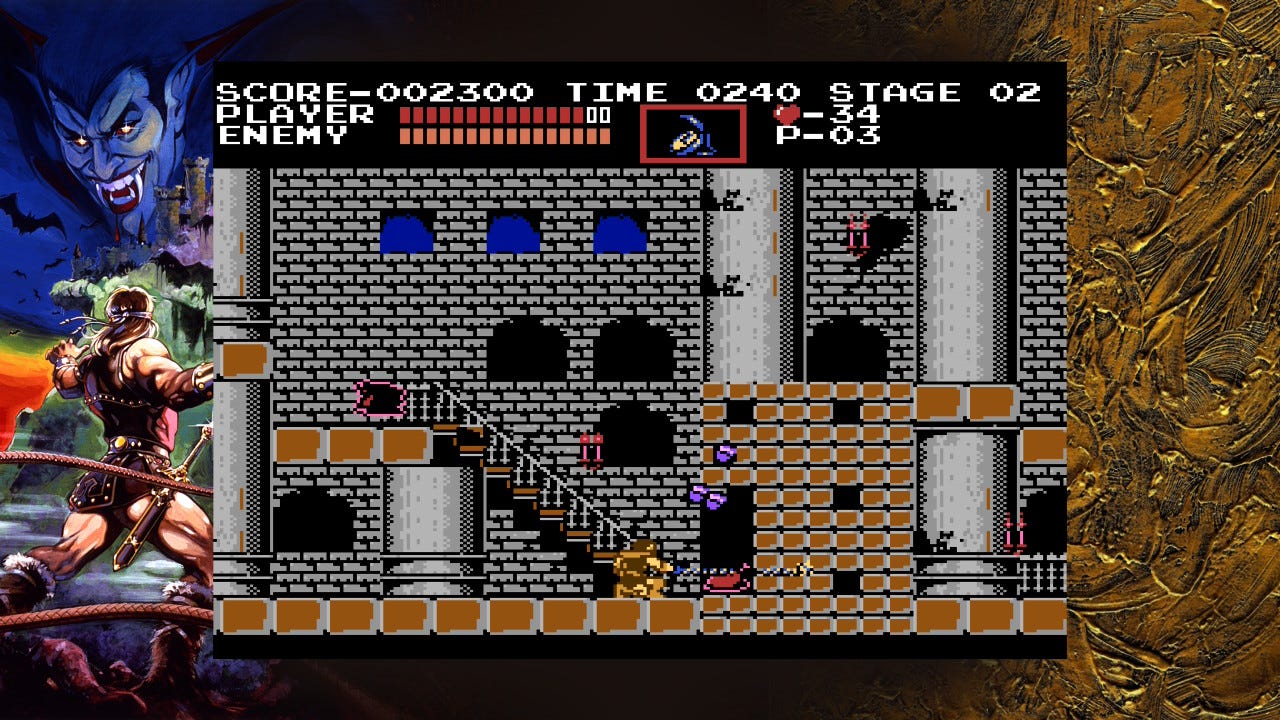
The second, less obvious purpose of the controls is to make the game feel grounded and tense. Castlevania oozes atmosphere for its era, using a moody but nonetheless vibrant color scheme that truly evokes a crumbling castle with monsters behind every shadow. The game demands a constant focus as your limitations force every threat to be taken seriously. Death comes quickly - only eight hits early on, but down to four by the end of the game - and the only way to heal is to break open walls for food; mistakes add up. The end result is that you truly feel, as much as anyone could back in the ‘80s, like a lone warrior facing down mortal dangers in the home of his supernatural enemy. I wouldn’t call this game “horror” insofar as it doesn’t really aim to scare you, but the challenge made every moment tense. Games today continue to limit what the player can do in genres like horror and action to raise the tension and keep players on edge. Though Castlevania remains a game of legendary difficulty, it’s the kind of challenge that gets you invested. It’s not a game you clear once just to say you could; it keeps you coming back to do it all again and get better and better every time.
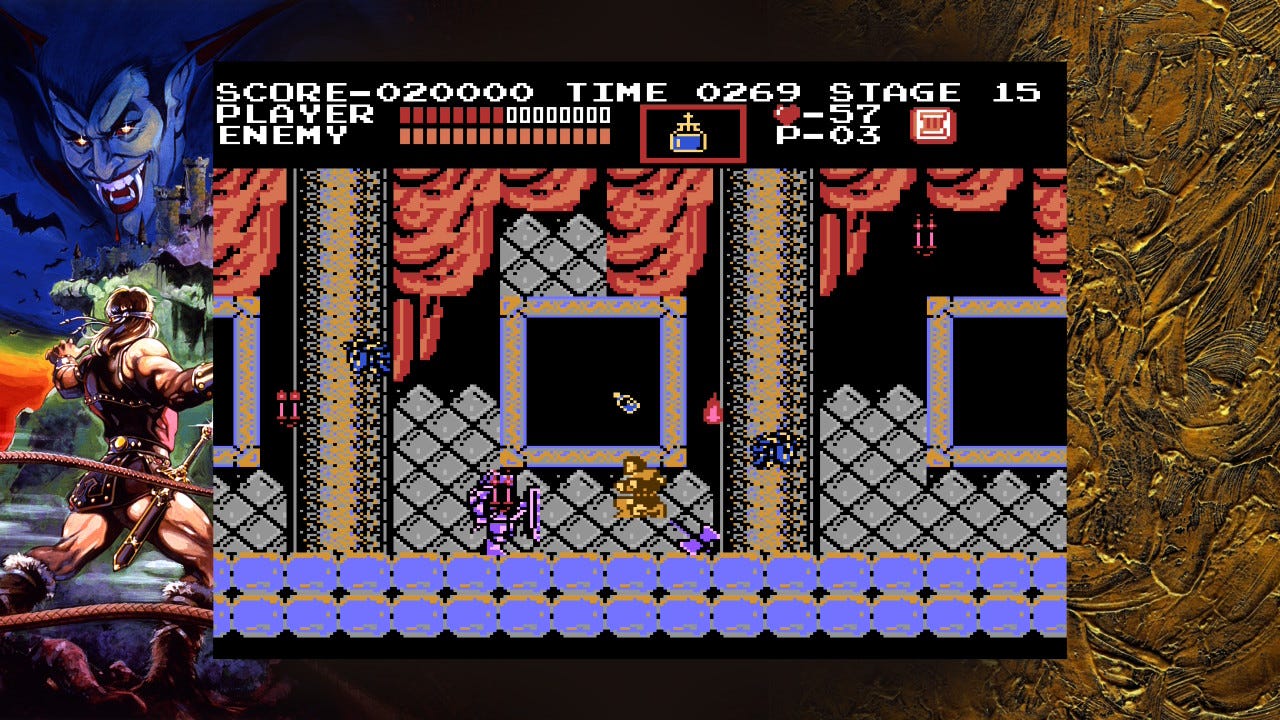
The style of gameplay in Castlevania would go on to be known as “classic-vania” in the wake of the series’ genre shift with 1997’s Castlevania: Symphony of the Night. Castlevania did a remarkably good job laying the groundwork for that style; many of its enemy and level design hallmarks would remain series staples, with every game putting its own spin on an increasingly recognizable design identity. However, Castlevania is admittedly not a perfect execution. Boss fights in this game are pretty bad, with most bosses simply meandering and firing projectiles here and there without much consideration for where the player can stand or move. Death, the penultimate boss, is a particularly miserable affair, covering nearly every inch of the screen with either his own swooping body or the sets of four floating sickles he releases periodically. Luckily, he’s got the same weakness nearly every other boss has: the holy water. By getting the holy water and collecting an upgrade that allows you to throw more than one on the screen at once, the continuous flame left where the water lands can trap bosses in place before they get a chance to do anything. It’s a cheesy tactic that doesn’t feel satisfying, but the later bosses basically demand it. The hallway leading up to Death ends up feeling more like the boss of the level than Death.
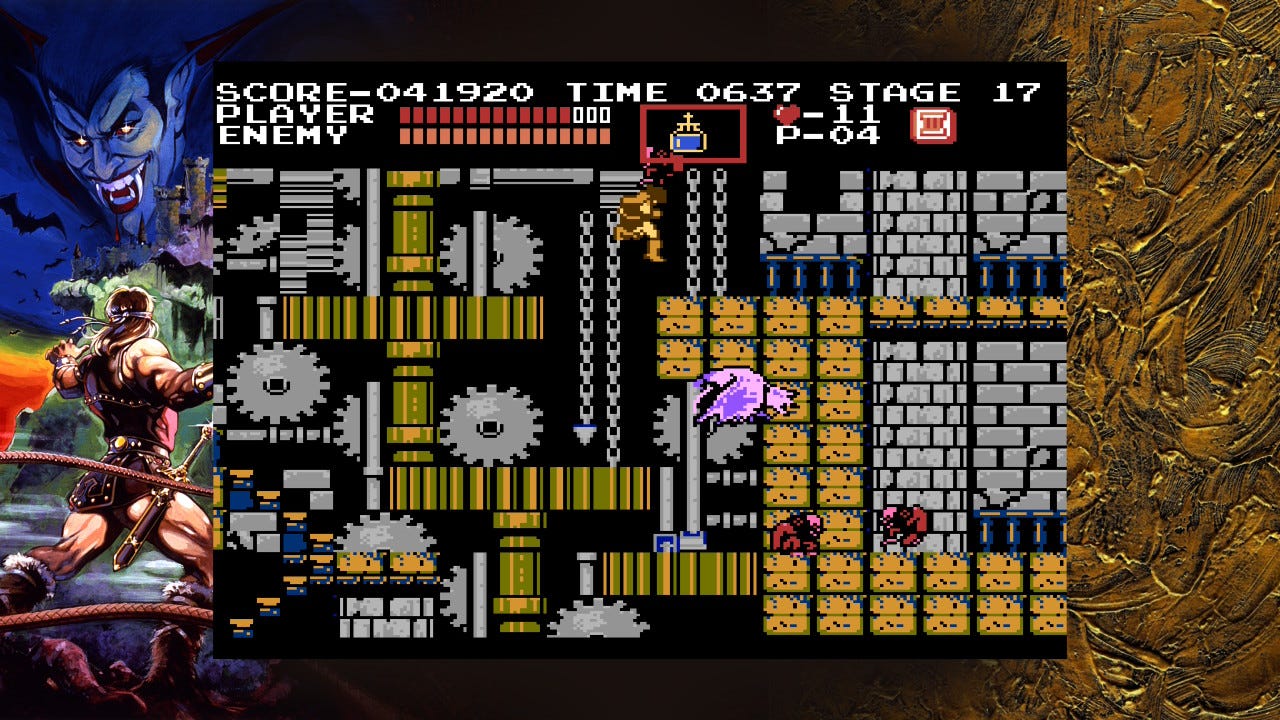
Every now and again, the level design can sort of trip over itself with antiquated, arcade-esque bullshit. Though the final level before Dracula is short, it’s filled with annoyances. It starts as you try to avoid about five giant bats - previously met as the game’s first boss - while you navigate a broken bridge to the clock tower. Once you’re inside, birds start swooping in and dropping fleamen everywhere, filling the screen in a way the game just doesn’t equip you to handle. Beating the game automatically starts a second, harder run where rooms can get arbitrarily filled with bats and medusa heads swooping in constantly. You basically need the time-stopping stopwatch sub-weapon to get any kind of break from the onslaught - I don’t recommend bothering with this mode. The game keeps track of score and hides secrets that only boost your score, still believing that score was something that actually mattered. At least certain score thresholds can occasionally give you an extra life. Still, for not having continues and being as generally fair as it is, Castlevania was well ahead of its time and a deeply important game in the early days of level design, difficulty, and atmosphere.
First of its Lineage
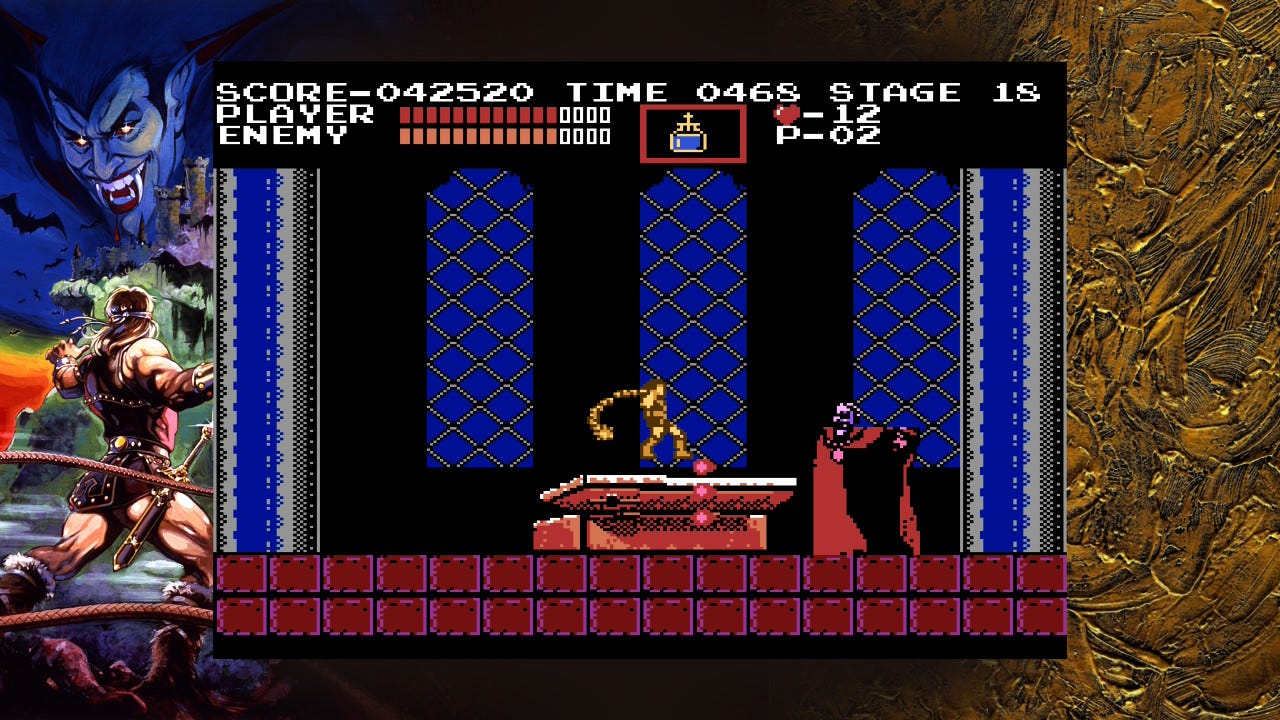
I mentioned before that Castlevania established a design identity which the rest of the series would continually build upon. That statement alone doesn’t cover just how often the series refers to this first game. Just about the only good boss battle in this game is the final one against Dracula; he has an actual attack pattern that you can strategize around, and he feels good to figure out. His moveset of teleporting, releasing fireballs, and transforming into a beastly form for his second phase would return in nearly every one of his many final boss appearances in the series, with most games adding little quirks or extra attacks to keep it fresh. Castlevania’s first level is recreated in almost exact detail multiple times throughout the series in both the classic-vania style entries and some of the later metroidvanias. The level themes within Dracula’s Castle, from the aforementioned entry hall to the torture chambers and gear-covered clock tower, are staple settings as the Castle is revisited again and again. The iconic staircase leading to Dracula’s vaunted quarters, with the clock tower and moon sharing the background, always makes for an epic build-up to the final confrontation.
One can point to many directly-recurring elements from this original game, but aspects of production also set the standard for the rest of the series in more general ways. No self-respecting critic could ever write a whole article about Castlevania without mentioning its music. Coming right out of the gate with the ever-iconic “Vampire Killer,” Castlevania’s music always fits the tone perfectly. The game opens with a championing anthem, moves into skulking tension with tracks like “Stalker” and “Wicked Child,” and gives you the motivation you need to power through its toughest challenges in the end with “Heart of Fire.” Castlevania was right at the top when it came to NES music, but it wasn’t just the music that pumped up the atmosphere. Castlevania’s vibrant color scheme emphasized high contrast between dark shadows and clear, distinguishable level elements like platforms and enemies. It looks almost like a game lit by torchlight - fitting for all the candelabras you break to collect hearts, points, and sub-weapons.
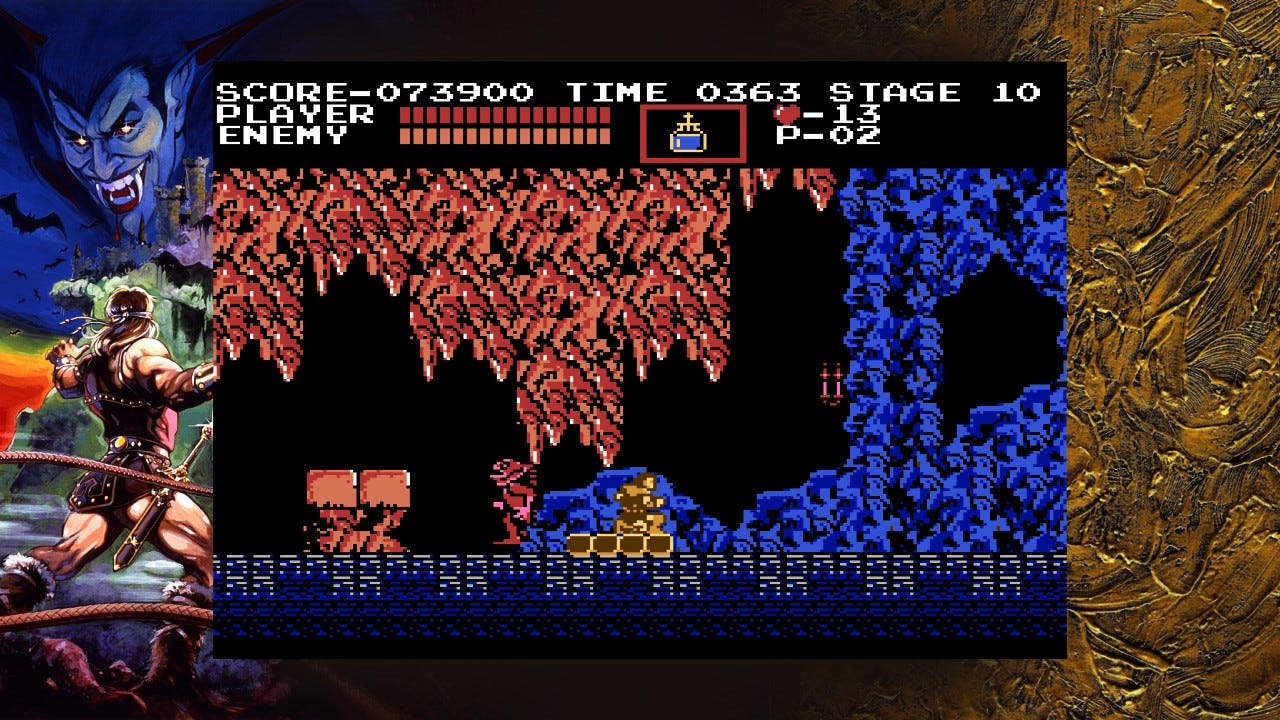
Castlevania’s strong command of the fundamentals throughout its visuals, sound, and gameplay makes it an NES game that has stood the test of time much better than the grand majority of its peers. It may not be the best of its kind anymore, and it shows its age in some places, but it’s all the more impressive for the simple fact that it was the first in the series. Many other classic franchises from the time, such as Mega Man, Metroid, and Street Fighter, wouldn’t really finding their footing until their second or even third entries. Even other classics of the time like The Legend of Zelda are obtuse and difficult to revisit by today’s standards, but Castlevania continues to be a valuable experience in its own right almost 40 years later. It goes to show that, even in the frontier days of game design, patience and care could result in something that could truly be called art.